
Article Details
EngineeringProduct
MVP to Scale: How to Build a Product That Won't Need a Rewrite in a Year
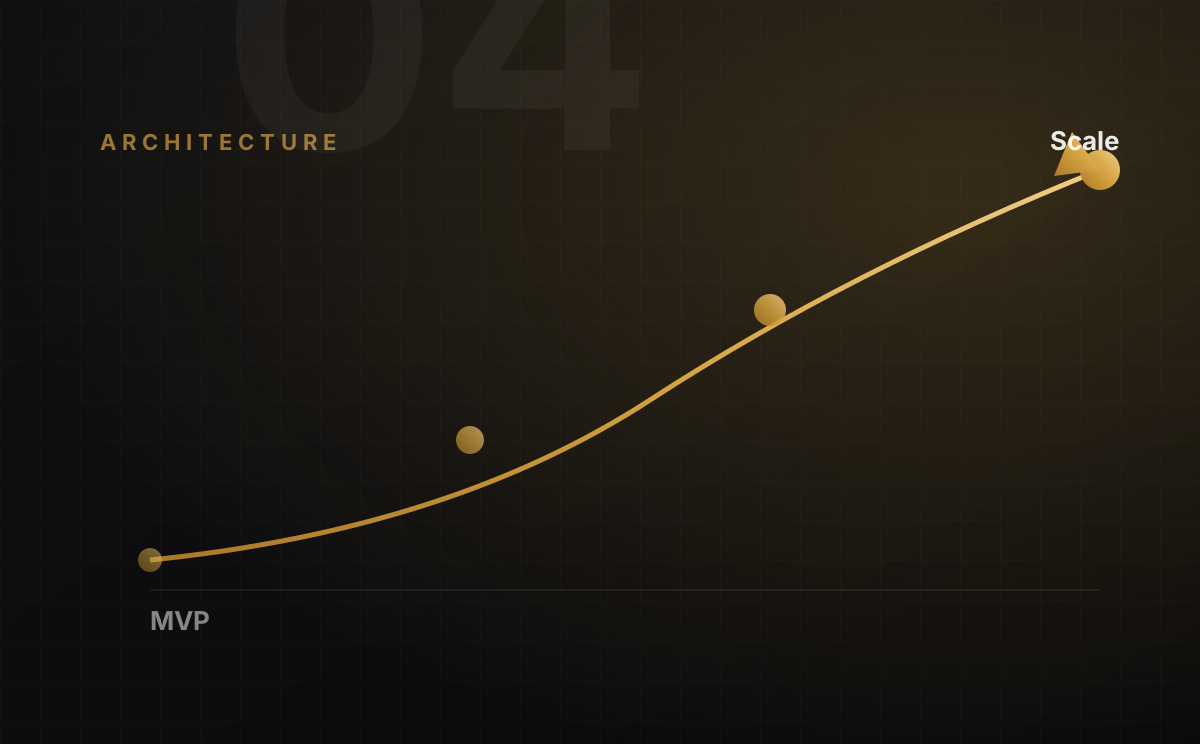
There is a myth that you have to choose between "fast and disposable" or "slow and solid." The best teams reject that trade-off. A well-built MVP is small on purpose — but the foundation underneath it is sound enough to grow on. Get the foundation wrong and you pay for it with a rewrite right when traction arrives.
Why MVPs get rewritten
It is rarely the feature count that kills an MVP. It is shortcuts that become load-bearing: tangled logic with no tests, a data model that cannot evolve, secrets hard-coded into the app, no path to deploy safely. None of these matter at ten users. All of them matter at ten thousand.
Decisions that buy you years
- A clean data model — get the core entities and relationships right; everything else is easier to change than this.
- Clear boundaries — separate business logic from the framework so you can swap parts without a teardown.
- Automated tests on the critical path — so you can change code quickly without fear.
- Real deployment hygiene — environments, migrations and rollbacks from day one, not bolted on later.
- Observability — logs and metrics so you find problems before your users do.
Build the smallest product you can — on the largest foundation you will not outgrow.
What you can safely defer
Scaling well does not mean over-engineering. You can defer microservices, multi-region infrastructure, heavy caching and elaborate admin tooling until real usage demands them. The skill is knowing which decisions are cheap to change later (most UI, most features) and which are expensive (data model, core architecture, ownership of your stack). Spend your early rigor on the expensive ones.
LaunchWe builds MVPs that are lean to launch and engineered to scale — and you own the whole stack, so growing it is always your call. Book a discovery and we will map the shortest path from first users to serious traffic.
Our News
Choosing Your First AI Workflow: A Scorecard
Six criteria, scored one to five. Anything under twenty is a second project, not a first one.
The Two-Week Paid Discovery That De-Risks a Six-Figure Build
Free proposals are priced to win work, not to be accurate. A paid discovery is the cheapest insurance a founder can buy.
Fixed Price, Time & Materials or Dedicated Team: Which Protects You
Every contract model moves risk somewhere. Here is where each one puts it, and the clauses that matter more than the model itself.
AI Features That Touch Customer Data: The Compliance Baseline
Before your agent reads a single customer record, seven controls need to exist. They take days to build and years to retrofit.